Enterprise Connect is right around the corner. It’s where I’ll be teaching attendees how best to negotiate cloud contracts, spot “gotchas,” and prevent them from happening in the future. Some of these “gotchas” include whether or not your service level agreement is providing protection and ensuring that your contract allows you to change providers when necessary. Here I’m going to highlight billing and give tips on how to avoid pitfalls.
But first. When should billing begin for your UCaaS or CCaaS services?
It seems like a simple question to answer. Most people would respond, “When I start using the services.” Sounds logical, right?
As a veteran technology consultant, I have reviewed many contracts. Billing start dates for new services can be quite arbitrary. For example, I’ve seen agreements that say billing will begin:
- 60 or 90 days after contract signature
- When the solution is ready for acceptance testing by the customer
- When the solution is substantially ready for activation
Only when your numbers are actually ported to the new solution can you really begin using the services. So, logically, your contract should state that billing commences when your numbers port.
When you transition to new services all at once, your billing start date is easy to manage, and it’s easy to check your bill for accuracy. But many transitions occur in phases, and this adds complexity. In this situation, there are two things you need to negotiate:
- The beginning date for billing services—In each phase, the billing date should begin when numbers port for that phase.
- The end date for the contract—For all phases, regardless of the start date for services, the end date for the contract should be the same (or “coterminous”), as depicted below:
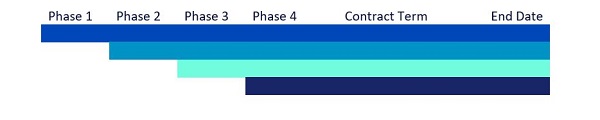
If you plan on a phased transition, you must track the date and quantity (by license or service type) of users that move during each phase. You will need this information to verify the accuracy of the billing. It’s much easier to collect this information when you’re already working with it as you prepare to port your numbers. It’s more difficult to go back and recreate the information later.
To recap:
- Billing should begin when numbers are ported.
- End dates should be coterminous.
- Maintain a record of port dates and quantities (by license or service type) so you can reconcile your bill later.
Will you be signing contracts for any cloud services soon? Would you like to know about potential pitfalls that could be lurking in those agreements?
If so, join me for my session at Enterprise Connect Virtual, “Don’t Get Caught by These Cloud Contract Gotchas.” I’ll share what you should look for to control your ongoing costs and ensure that service level agreements provide real protection. I’ll also address tactics vendors may use to make it difficult for you to change providers in the future. Get your free virtual pass today!
Related Articles:
Choosing UCaaS: What Works for You?
If you're thinking of using a cloud UC provider, be sure you understand the differences among solution types before making a decision.
Infrastructure Considerations for VOIP
All new communication technology utilizes VOIP (Voice Over IP) technology. If you want to install a new solution, it will use your data network to carry voice traffic.
Is the RFP Process a Waste of Time?
An RFP that is issued at the proper time in the process, is supported by a thorough needs analysis, and clearly articulates the requirements of the organization, is an effective tool.
Hosted Services – Dangerous Waters Ahead?
We would be well-served to learn from lessons of the past and include an evaluation of a provider's financial stability during the buying process for hosted services.